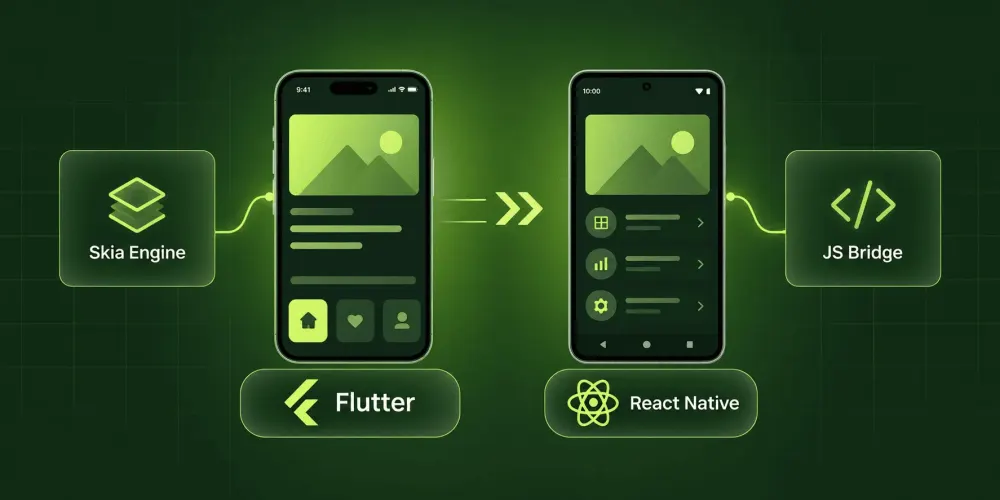

Flutter vs React Native: 2026 Mobile Playbook
Choosing between Flutter and React Native is the defining decision in cross-platform app development for 2026. Both let you build once and deploy to iOS and Android, but they differ in rendering, performance, and ecosystem. The right pick depends on your team, timeline, and how native your product needs to feel.
Cross-Platform Strategy
Mobile apps are no longer extensions of a brand; they are the brand. As users demand more speed and less friction, successful cross-platform app development balances high-performance code with intuitive interfaces. VTechnocrat helps you match the framework to your roadmap so you reach every user without doubling your build cost.
Flutter Rendering
React Native Bridge
"A great mobile app does not just provide a service; it integrates seamlessly into the user’s lifestyle, becoming an indispensable tool they reach for without a second thought."
How to Choose Your Framework
Pick Flutter when you need pixel-perfect custom UI, high-motion interfaces, or a single design language across platforms. Pick React Native when your team already lives in JavaScript, you need tight web-and-mobile code sharing, or you rely on a mature native module ecosystem for speed.
- Real-time Push & Cloud Sync
- High-Performance API Integrations
- Biometric & Secure Auth Systems
Both frameworks now deliver near-native performance for the vast majority of apps. Flutter’s compiled Dart and new engine reduce jank in animation-heavy screens, while React Native’s new architecture and JSI cut bridge overhead. For most products, team skill decides delivery speed more than raw benchmarks.
Performance in the Real World